Developing Advanced Methods for Nuclear Quantum Effects on Emergent Phenomena in Molecular and Condensed-Phase Systems
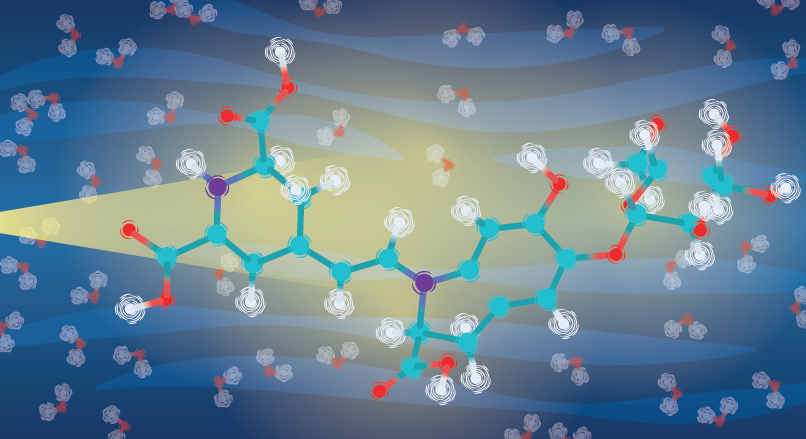
Quantum mechanics governs not only electrons but also the motion of atomic nuclei, particularly light ones like hydrogen. These nuclear quantum effects (NQEs), including zero-point energy, tunneling, and delocalization, are essential to understanding hydrogen bonding, isotope behavior, proton transport, and chemical reactivity in molecular and condensed-phase systems. While NQEs are important in ground-state phenomena, they are even more impactful in electronically excited systems. When molecules absorb light or undergo charge rearrangement, nuclear motion couples with electrons and spins. This interplay governs energy transfer, charge separation, vibrational relaxation, and spin transport. These processes are central to light harvesting, catalysis, and quantum materials.
Our vision is to uncover how the quantum behavior of light nuclei, such as hydrogen, shapes molecular and materials function through its influence on energy, charge, and spin transport.
This project brings together researchers in theoretical chemistry, quantum dynamics, applied mathematics, high-performance computing, and machine learning to build accurate, scalable tools to enable predictive insight into quantum-driven phenomena across chemistry and materials science.
Objectives
- Develop many-body methods that incorporate NQEs in simulations of excited-state processes and spectroscopic signatures.
- Design efficient algorithms and integrate machine learning to enhance the performance and usability of NQE methods, delivering them through open-source software optimized for supercomputers.
- Apply these tools to study coupled electron, proton, and spin transport in realistic systems and compare predictions with experiment.
Achieving this vision will help the research community address two key scientific questions:
- How does the quantum nature of light atoms depend on their structure and environment?
- What role do nuclear quantum effects play in energy flow, coherence, and photoinduced processes in electronically excited molecular and material systems?
Funding
This research is supported by the U.S. Department of Energy, Office of Science, through the Scientific Discovery through Advanced Computing (SciDAC) program, with funding from Basic Energy Sciences (BES) and Advanced Scientific Computing Research (ASCR) under FWP 85742 at Pacific Northwest National Laboratory.
The NuQuantEm project is part of the Genesis Mission.